Marketing and customer inbox on autopilot
Fotobazoš.cz
- n8n (workflow orchestration)
- PostgreSQL
- Language models through a custom gateway
- Telegram (approval)
- Docker on a custom server
What it changed
- The owner only approves
- Posts, replies to comments, and emails arrive ready on the phone. It saves hours of work; all it takes is a tap.
- Social proof
- The profile is active regularly, not sporadically. Reviews and comments receive replies, so it is clear that someone looks after customers.
- Significantly better SEO and GEO
- Every post leads to an article or category, and content grows. Search engines and AI assistants have something to find and cite.
- Community and the store's story
- Advice, tips, and news build the company's story. People return even when they are not buying anything right now.
Starting point
The owner runs the store herself. Social media posts, replies to comments and reviews, and sorting the shared inbox were all manual work between photography and packing orders. Marketing therefore happened when time was left over, not when it was needed.
Solution
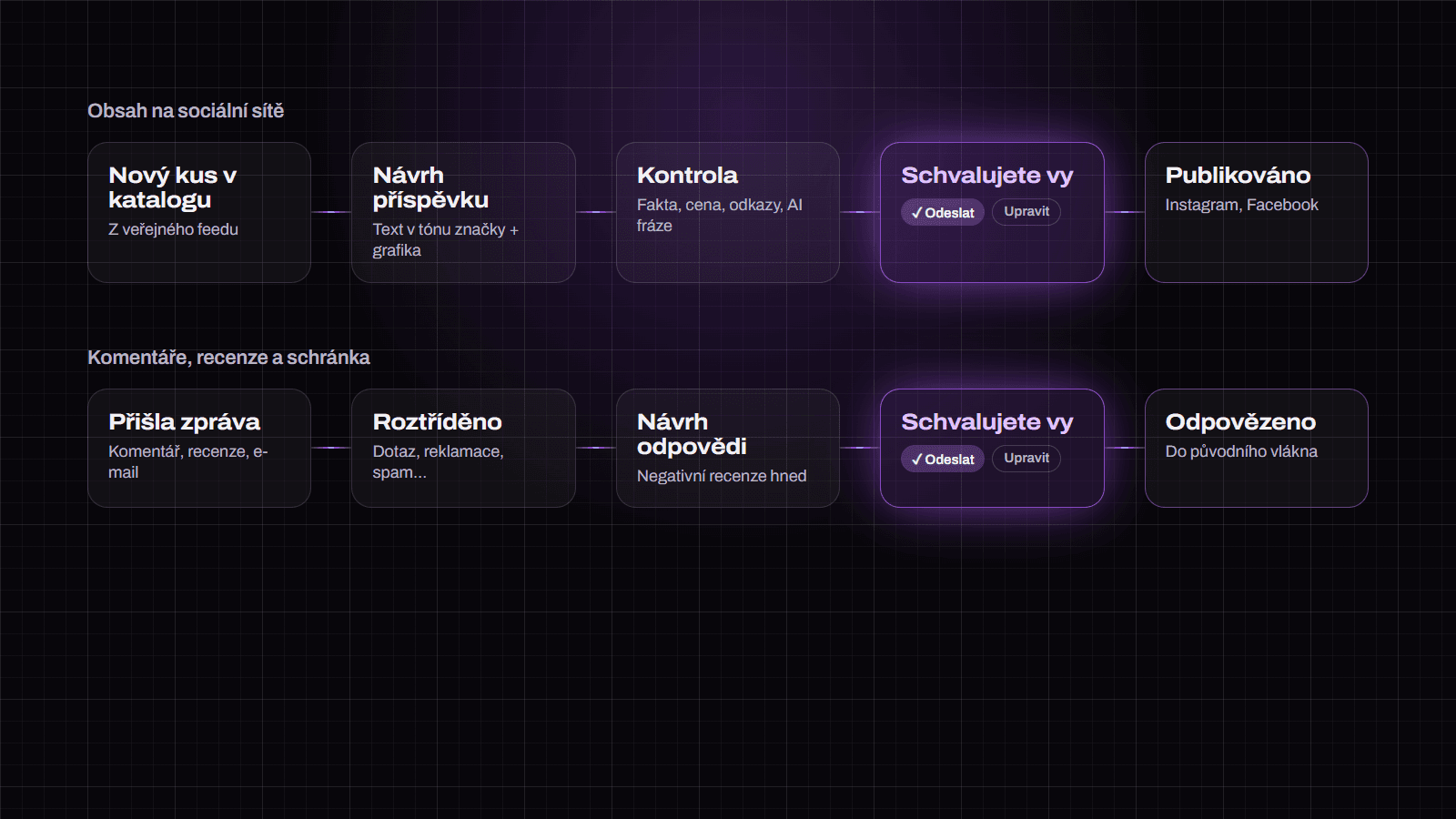
A system that runs beside the store, not inside it. It prepares posts from the catalog, creates products from one photo, watches comments, reviews, and inboxes, and suggests replies. The owner approves everything that goes out with one tap on her phone.
Beside the website, not inside it
The automation does not touch the online store's code or database. It reads only what is public or intended for it: the product feed, sitemap, and analytics interface. If the automation stops, the store continues running unchanged.
Posts from the catalog
A new item in the catalog becomes the basis for a post. The system writes copy in the brand's tone, renders graphics from a template, and sends a draft for approval. Before that, a validator checks that facts and price match the catalog, links work, the text contains no typical AI phrases, and it does not repeat what has already been published. Anything that fails goes back to the model for correction.
Comments, reviews, and inbox
Comments from Instagram and Facebook, reviews from the Google profile and Heureka, and incoming emails are sorted, and those needing a reply receive a suggested response. A negative review does not wait in the queue: it arrives immediately as a notification with a suggested reply.
Autonomy is earned
Each action type starts with approval. The system records how often the owner sends a draft unchanged, edits it, or rejects it. Only what proves itself over time may run without asking, and it can always return to approval.
AI stock clerk: a product on the website from one photo
Every item in a used-goods store is different, so creating a product meant photographing it, editing the photo, researching the price, writing a description, and filling in the admin. Now the owner only photographs it and approves the price; the system prepares the rest. It runs in production.
- The owner takes a photo of the productWith her phone, just as it lies on the table. She does not need to do anything else.
- Product photoThe system processes the photo and turns it into a clean product photo for the online store.
- Price suggestionWhen the price is missing, a research agent suggests one based on the product, the photo and any description.
- VerificationA verification layer checks that the details are correct and real. Anything that does not add up goes no further.
- The owner approves the priceWithout her confirmation, the product is not published.
- The product is on the websiteWritten to the online store database. The sitemap and Search Console are updated daily.
Estimate: done by hand, one product takes about 30 minutes (taking photos, editing the photo, looking up the price, writing a description, adding it in the admin). With the system, about 3 minutes - take a photo and approve the price. For every 10 products, that is roughly 4.5 hours of work (10 × 27 min).
Monthly report
Once a month, a summary arrives from analytics, Search Console, and Merchant Center: what sold, what people searched for, and where the catalog has problems. Without opening five different tools.
What we measure
The system runs in production. That is why we describe the results above in words: we are not publishing saved hours or revenue from posts yet, because we have only been measuring them for too short a time for the numbers to be conclusive. We will add them here once they are.
Want a similar result?
I want an analysis of my process